Sampling and Testing
Elastizell Corporation of America
Get Accurate Material Analysis Through Professional Sampling and Testing
Accurate sampling and testing of building materials ensures your project meets all specifications and safety standards. Elastizell provides comprehensive sampling and testing services throughout North America, helping contractors, engineers, and builders confirm material quality before installation. Our team follows industry-standard protocols to deliver reliable results for your construction projects.
Our material analysis services include density testing, compressive strength evaluation, thermal conductivity measurements, and fire resistance assessments. Contact us to discuss your specific testing needs.
Method for Sampling Low-Density Elastizell Concrete
- A representative sample of Elastizell material (4-3×6-inch) cylinders shall be sampled. For Elastizell EF projects that would be every 4 hours or for each 300 cubic yards of material placed. For Elastizell roof decks, it is suggested that a sample be taken every 4 hours or for each 100 cubic yards of material placed. For Elastizell floor fills, a sample for every 4 hours or from each ready-mix load is recommended. The samples should be filled from a density check, at the point of placement, with the time and location noted on the field report. A testing lab is not required for this procedure.
- The box cores (cylinders) shall be overfilled by pouring the Elastizell down the sides of the cores. This allows air to escape during filling. Tap the box on the sides and bottom to close any accidental entrained air voids. Strike off the samples and cover the box. DO NOT ROD ELASTIZELL CYLINDERS!
- Mark the box and place it in a location where it will not be disturbed or subjected to temperature extremes. Excessive or early handling may damage these test cylinders. Normally, after 2-3 days, the cylinders and field test report may be shipped.
- The importance of proper handling of these samples cannot be overemphasized. They are representative of the material placed. Their careful handling, storage, early curing, and proper shipping are extremely important. After 24 hours of initial set in a location free of vibration and temperature extremes, it is recommended that they be placed in a warm, high-humidity environment until shipped to the testing facility.
Quality Assurance Processing of Incoming Cylinders
- Incoming Elastizell cylinders are unpacked upon arrival and documented first in a shipping log. The applicator, job name and location, date, and cast density are recorded along with any other pretinent information included by the sender. The cylinders are sent to the testing room for labeling and stripping.
- Before the curing and testing process begins, any paper labels are removed from the cylinders and/or their boxes. The cylinder information is transferred onto the cylinders with permanent markers. This ensures proper identification of each cylinder, even after extended curing that might destroy stickers or labels.
- Once labeled, the cylinder’s identifying information is entered on computer spreadsheets. These spreadsheets include strength and density calculations. The cylinders are scheduled for compressive testing on a calendar. Whenever possible, samples are tested upon receipt and at 28 days. Occasionally, tests are also conducted at 56 days in order to track strength gains during the curing process.
- Cylinders received more than 28 days after casting are stripped, labeled, and tested as soon as possible, often on the day of receipt. The remaining cylinders may be placed in cure for testing at 56 or more days.
- Cylinders received soon after casting may be left unstripped in cure tanks for a few days so that they may harden properly for clean stripping.
- Some samples may be oven-dried. When the density is constant after subsequent weighing, the cylinder is removed from the oven and labeled “oven-dried”. Oven-dried cylinders are never tested for compressive strength.
Method for Stripping Low-Density Elastizell Cylinders
- A quarter of the cylinder box (containing one of the test cylinders) is cut from the cylinder box with a saw.
- The bottom of the polystyrene form is scored in a tic-tac-toe pattern with a knife. Care is taken not to cut into the concrete cylinder inside. The squares of polystyrene are removed to expose the bottom of the cylinder.
- The sides of the polystyrene form are scored vertically. Again, care is taken not to cut into the concrete cylinder. Peel the sides off of the cylinder like removing a banana from its peel. Special care is taken with very low-density samples to avoid damaging the cylinders.
Method for Capping Elastizell Test Cylinders
Elastizell concrete has a variable density ranging from 20 pcf to 120 pcf. Because of this fact and the atypical ingredients (air, but no sand nor lightweight aggregate), this material does not fall under the current test procedures. As a result, the testing guidelines are those recommended by the manufacturer.
- The sample should be stripped, trimmed and prepared per approved Elastizell procedures. (See method for stripping low-density Elastizell cylinders above).
- Apply oil or an appropriate release agent to the horizontal capping surface. The surface should be a flat and level sheet of steel, plastic, Formica, or other non-porous surface.
- Mix an appropriate amount of US Gypsum hydrostone for the number of cylinders being capped. Add water (US Gypsum suggests a ratio of 32 parts water to 100 parts hydrostone) and mix throughly. The mixed material should have the consistency of pancake batter.
- Place a pond approximately 3-1/2 inches in diameter for each 3×6-inch cylinder being capped on the pre-oiled capping surface.
- Stand the cylinder in the center of each pond in a vertical position.
- After the capping material begins to set (about 10-15 minutes), it should be trimmed around each test cylinder. The material may either be pushed into and slightly up the side of the cylinder or pulled away from the cylinder, leaving a radius of about 1/4-inch around the cylinder. The setting time will vary depending on factors such as the dryness and composition of the cylinder and the ambient temperature and humidity.
- Allow the hydrostone to completely set.
- Before the test sample is moved, tap the capping surface to break the seal between the sample and the casting surface. Carefully remove the sample.
- Clean off the capping surface, re-oil, and repeat the procedure for the other end of the cylinder.
Information regarding hydrostone such as the physical properties, instructions, and the MSDS may be found on US Gypsum’s website.
Method for Testing Low-Density Elastizell Cylinders
- Upon receiving the box of cylinders, it should be placed into the curing environment. After a few days, remove the cylinders from the box (see method of stripping above).
- Moist cure up to 24 hours prior to compressive testing. Do not test cylinders in the moist condition. One cylinder may be oven-dried for an oven-dry density determination. DO NOT OVEN-DRY ELASTIZELL CYLINDERS WHICH ARE TO BE TESTED FOR COMPRESSIVE STRENGTH (see ASTM C796 – Sections 8.9 and 8.10)!
- The cylinders should be capped with a fast-setting, gypsum cement (hydrostone by US Gypsum) prior to compressive testing. Do not use hot sulphur caps. Document test results and send to the Elastizell applicator.
Note: Cylinders cast at low densities and those made with partial cement replacement or made with pozzolans may be quite fragile – even at 7 days – such that clean stripping is difficult. We recommend waiting to strip the cylinder until a few days before the test date. If damage occurs or soft bottoms are encountered, trim the cylinder bottom prior to capping and testing and apply appropriate correction factors (ASTM C42 Section 6.7).
These methods are based on manufacturer recommendations in combination with ASTM standards.
Test Machine Information
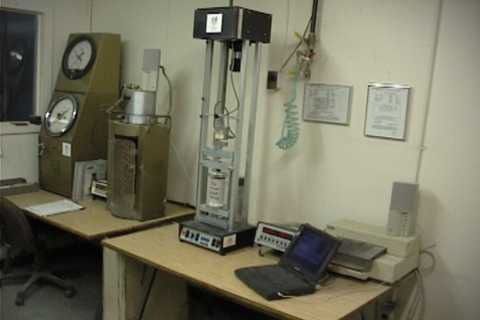
Elastizell uses a low-range test machine specifically for testing our low-density concrete samples.
Typical concrete test machines may have a range of 0-100,000#, with the greatest accuracy being in the mid range. We use a ComTen 955KRC0100 machine with a range of 300-5000# so that low density Elastizell roof deck and EF samples are more accurately tested.
Elastizell also has a high-range test machine for breaks requiring a load greater than 5,000 pounds.
The care and calibration of our machines is a priority.
- Bullet text
- Bullet text
- Bullet text
- Bullet text
- Bullet text
- Bullet text
- Bullet text
- Bullet text
- Bullet text
- Bullet text
Title or Question
Describe the item or answer the question so that site visitors who are interested get more information. You can emphasize this text with bullets, italics or bold, and add links.Title or Question
Describe the item or answer the question so that site visitors who are interested get more information. You can emphasize this text with bullets, italics or bold, and add links.Title or Question
Describe the item or answer the question so that site visitors who are interested get more information. You can emphasize this text with bullets, italics or bold, and add links.

CP #1 Headline
CP #1 Body
CP #1 CTA Lead-in
Not valid with any other offers or promotions. Restrictions apply.
Must mention this coupon at the time of scheduling.
Gallery Heading H2
Reviews

Expert Workmanship
You Can Trust
We deliver precise building materials and reliable results that stand the test of time.
Call Us Today
Related Services